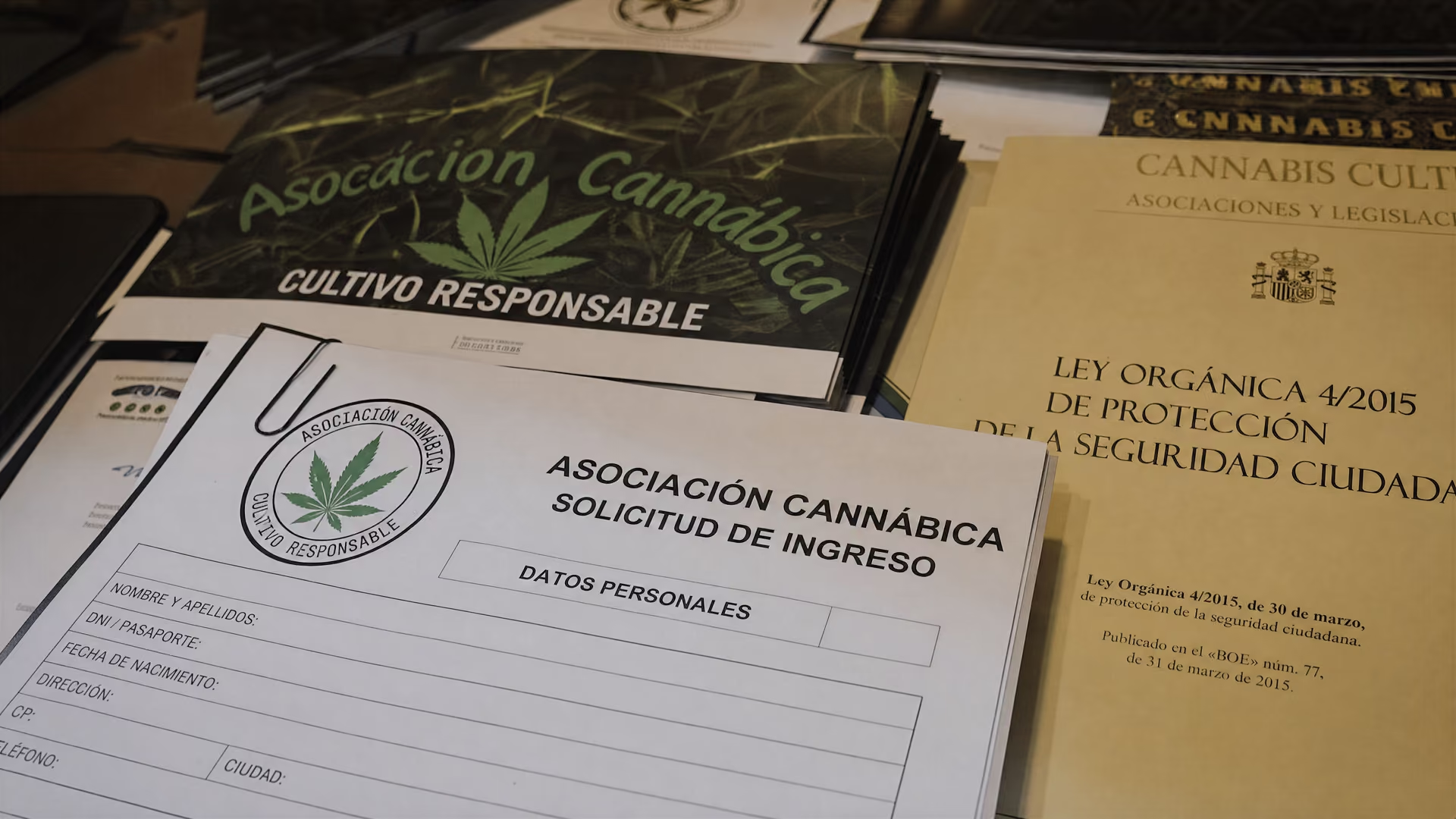


Spain’s cannabis associations face legal uncertainty and closure risks. Gran Canaria’s debate shows why private clubs remain in a contested space.

A Spanish cannabis association faces imminent closure after 13 years of activity, sharpening a national dispute over how private, members-only associations should operate. The issue has particular relevance in Gran Canaria, where the legal status of cannabis associations remains contested rather than settled. The wider dispute is examined in a report on Spain’s associations fighting the legal vacuum, while recent court decisions and local interventions show why association registration alone does not remove criminal-law risk.
Spain’s private-club model meets an unresolved legal boundary
Cannabis social clubs in Spain are private, members-only, non-profit associations. They are not shops, dispensaries or open public venues, and a visit to Gran Canaria does not create an automatic right to join or enter one. Membership is a private matter decided by each association. That structure is central to the current debate, but it does not amount to a blanket authorisation under Spanish criminal law.
The legal vacuum exists because association status and criminal-law protection are not the same thing. An organisation may present itself as a private association while still facing questions about how it operates, who may participate and whether its activities fall within the boundaries recognised by the courts. For associations, that uncertainty affects day-to-day decisions as well as their longer-term survival.
Why Gran Canaria is part of the national question
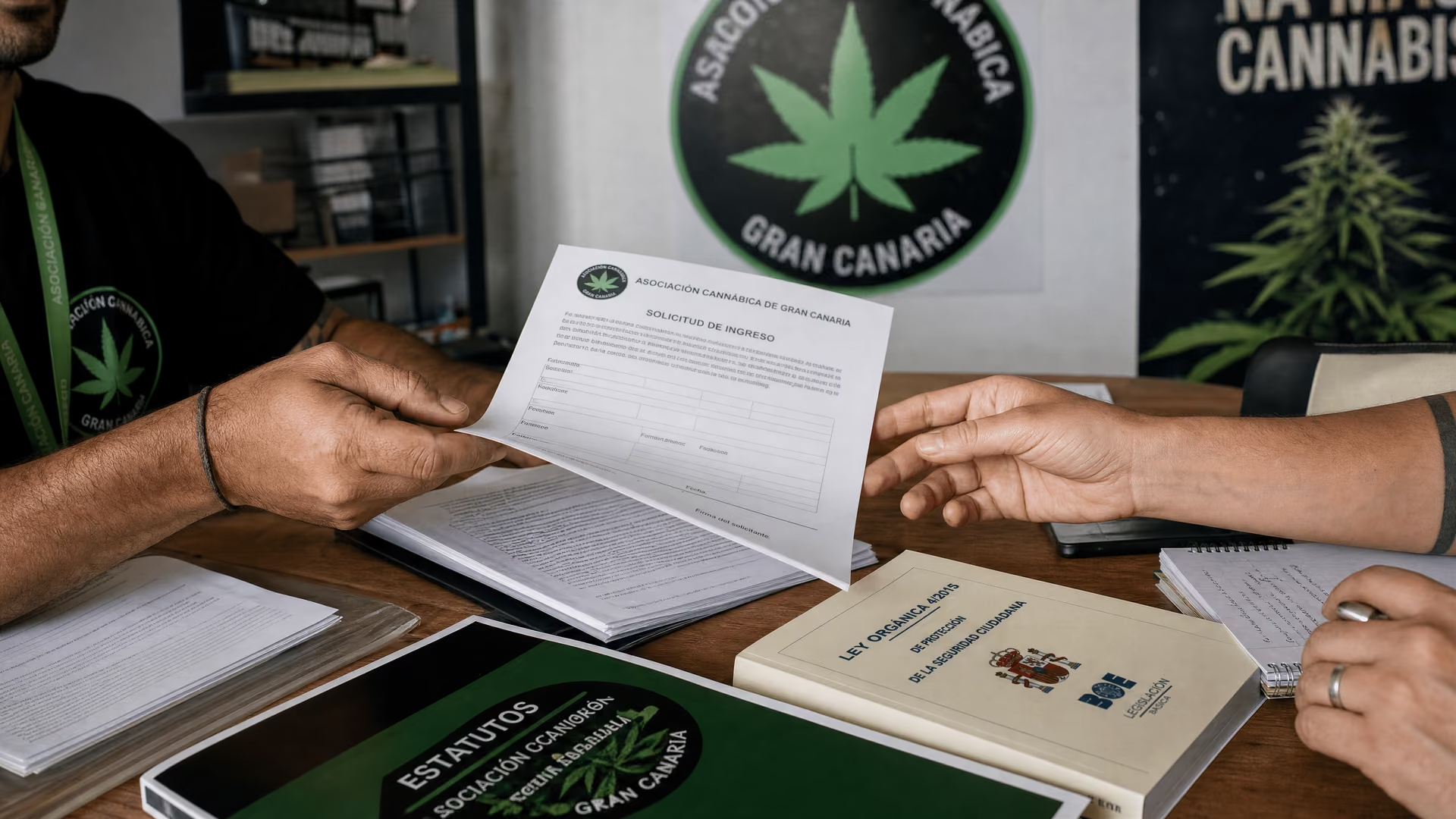
Court rulings have narrowed the operating space without filling the gap
Recent court decisions have pushed associations towards a more clearly closed membership structure. A legal analysis by Cáñamo explains that associations seeking to cultivate and distribute cannabis among members must operate with membership restricted to a defined group. The same analysis warns that meeting that condition does not guarantee criminal-law legality.
That distinction is important for readers in Gran Canaria because it prevents two opposite misunderstandings. A club cannot be treated as an ordinary retail business simply because it has an association structure. At the same time, the existence of legal uncertainty does not mean that every association is automatically unlawful. The facts of each organisation and the way it operates remain decisive.
The practical implications of the recent rulings can be reduced to several points:
- Membership must remain closed rather than functioning as open public access.
- An association structure does not by itself guarantee protection under Spanish criminal law.
- The boundaries around cultivation and distribution among members remain legally sensitive.
- Visitors to Gran Canaria should not assume that being in the region provides access to any association.
- Each association decides its own membership arrangements as a private matter.
The result is a framework that sets limits without offering the certainty associations say they need. The analysis of Spain’s latest court decisions is therefore relevant not only to lawyers, but also to associations deciding how to maintain a closed structure while avoiding conduct that could be interpreted as commercial distribution.
Gran Canaria’s debate is local, but the legal question is national
The Canary Islands have their own local pressure points within this national uncertainty. A reported intervention involving a cannabis association in Arona renewed debate over how such organisations should be regulated. The episode does not establish a general rule for every association, but it shows how quickly questions about a club’s legal status can become a matter for local authorities and public debate.
Other reporting on the islands distinguishes between recreational use, medicinal cannabis, and authorised industrial or research activity. Those categories should not be treated as interchangeable. For Gran Canaria residents and international readers, the distinction matters because the existence of a regulated medical or industrial activity does not turn a private association into a public retail outlet.
The reported developments illustrate how different parts of the legal and administrative picture fit together:
| Reported development | What the facts establish | Source |
|---|---|---|
| Association model | Closed membership is required for associations seeking to cultivate and distribute among members, but that structure does not guarantee criminal-law legality. | Adapting to the latest rulings |
| Closure risk | One association says it faces imminent closure after 13 years and objects to a debate focused on legal issues rather than social consequences. | Association fears closure after 13 years |
| Arona intervention | An intervention involving a cannabis association renewed the debate over regulation in the Canary Islands. | Arona reopens the debate on cannabis associations |
| Dénia investigation | Six people were arrested after a club registered as an association was investigated over alleged drug sales; the allegation concerns that case, not all associations. | Six arrests in a Dénia club investigation |
For Gran Canaria, the lesson is that local interventions cannot be separated from the unresolved national framework. Municipal authorities may encounter individual establishments, while courts and Spain’s criminal-law system determine whether the underlying conduct falls within a legally defensible association model.
Closure risk makes the dispute social as well as legal
The association that says it faces imminent closure after 13 years of activity has placed a second issue beside the legal argument: what happens to the community built around an organisation when its doors are shut? According to the reported account, the association criticises a debate centred on legal questions while giving insufficient attention to the social consequences of closure.
The association’s position is that the consequences of closure cannot be reduced to a legal technicality.
Reported position of the association facing closure
That argument does not settle the legal question, and it does not prevent authorities from investigating suspected unlawful activity. It does, however, explain why the dispute is not simply about paperwork or the wording of an association’s statutes. For members, organisers and local communities, a closure can end an established social structure even when the wider legal framework remains unresolved.
Reports from elsewhere in Spain show the pressure created when an association structure is linked to allegations of sales. In Dénia, six people were arrested after police investigated a club registered as an association over alleged drug sales. Such cases must be assessed individually, but they also help explain why courts and police do not treat association status as decisive on its own.
Two figures show the different dimensions of the dispute:
Why individual cases cannot become a general verdict
An alleged offence at one club does not establish that every private association operates in the same way. The reverse is also true: the existence of associations that describe themselves as non-profit and member-based does not prevent police or prosecutors from examining individual conduct. That tension is at the heart of the legal vacuum now being debated in Spain and followed closely in the Canary Islands.

What a clearer framework would need to settle
The available facts point to a set of unresolved questions rather than a settled legal solution. Spain’s courts have clarified the importance of closed membership, but the reported legal analysis expressly stops short of treating that condition as a guarantee. Associations therefore remain exposed to disputes over the line between private collective activity and conduct that authorities may view as criminal.
- How association registration relates to the limits of Spanish criminal law.
- Which activities involving members remain defensible after recent court decisions.
- How local authorities should distinguish a private association from an establishment operating as a retail outlet.
- How the social consequences of closure should be considered alongside legal enforcement.
- What consistent standards should apply across the Canary Islands and the rest of Spain.
Until those questions receive a more consistent answer, the legal vacuum will continue to produce uncertainty for both sides. Associations may try to adapt their structures, while authorities may continue to examine whether individual operations stay within the boundaries recognised by the courts.
Questions readers in Gran Canaria often ask
Understanding cannabis associations in Spain
Are cannabis social clubs shops or dispensaries?
No. In Spain they are private, members-only, non-profit associations. They are not open-public shops or dispensaries.
Does joining an association guarantee criminal-law legality?
No. Recent legal analysis states that closed membership does not by itself guarantee legality under Spanish criminal law.
Does closed membership resolve the entire legal issue?
No. Recent court decisions have made a closed membership structure an important condition for associations seeking to cultivate and distribute among members, but the wider legal position remains unsettled.
Does visiting Gran Canaria provide access to an association?
No. Travelling to Gran Canaria does not create access rights. Membership is a private matter decided by each association.
The central findings are:
For Gran Canaria, the dispute is not about whether association status settles the matter; the reported legal position says it does not. The unresolved question is how Spain will distinguish legitimate private association activity from conduct that falls outside criminal-law protections, while addressing the consequences for organisations and communities that have operated for years. Until that boundary is made clearer, the legal vacuum will remain the defining fact of the cannabis-association debate.
Sources
- Adaptarse a las últimas sentencias (canamo.net)
- Una asociación que teme desaparecer tras 13 años de lucha y ante un cierre inminente (eldiarioalerta.com)
- Arona reabre el debate sobre asociaciones cannábicas (cannarias.net)
- Seis detenidos en Dénia al desmantelar un club cannábico donde presuntamente vendían drogas (europapress.es)